
How We Find Hidden Water Leaks Behind Walls and Under Concrete Slabs
Some of the most destructive property damage doesn't happen with a dramatic burst pipe. Instead, it happens silently. A pinhole copper pipe leak inside a bathroom wall or a hot water line fracture beneath your concrete slab can leak for weeks before visible signs appear. Here is the technical guide on how modern restoration diagnostics locate concealed plumbing breaches with sub-inch accuracy without destructive demolition.
📋 Table of Contents & Technical Navigation
- Mechanics of Concealed Plumbing Failures in Florida
- 7 Physical Warning Indicators of Hidden Leaks
- The Physics of FLIR Thermal Infrared Leak Detection
- Pinless vs. Pin-Type Moisture Meters: Calibration Standards
- Acoustic Frequency Ground Microphones for Slab Leaks
- Borescope Video Inspection and Tracer Gas Methods
- Step-by-Step Homeowner Protocol When a Leak is Confirmed
1. Mechanics of Concealed Plumbing Failures in Florida
Plumbing infrastructure in Central Florida homes experiences specific environmental stressors that lead to silent concealed pipe failures:
- Pitting Corrosion in Copper Supply Lines: Municipal water chemistry containing chloramines and dissolved oxygen causes aggressive galvanic micro-pitting in Type M copper pipes, creating microscopic pinholes that spray fine water mist inside wall cavities for weeks.
- CPVC Thermal Cycling Embrittlement: In hot attic chases where temperatures exceed 130°F during summer months, chlorinated polyvinyl chloride (CPVC) piping becomes extremely brittle, cracking at glued elbow fittings under standard 60 PSI municipal pressure.
- Sub-Slab Copper Expansion Friction: In slab-on-grade homes, copper hot water lines embedded directly in concrete without polyethylene sleeving expand and contract thousands of times per year. Continuous friction against abrasive aggregate wears through the pipe wall, releasing dozens of gallons per hour beneath flooring.
2. 7 Physical Warning Indicators of Hidden Leaks
Seminole County homeowners should monitor for these distinct physical and acoustic indicators of active plumbing breaches:
- Municipal Water Consumption Spikes: An unexplained increase of 3,000 to 10,000 gallons on your monthly Sanford utility bill signals a continuous pressurized line fracture.
- Low-Flow Meter Indicator Movement: Shut off all faucets and appliances. Inspect your outdoor meter box. If the low-flow indicator (small red triangle or blue gear) continues spinning, water is actively escaping.
- Hot Floor Tile Anomaly: In slab-on-grade homes, a localized warm patch on ceramic tile or vinyl plank flooring indicates an active domestic hot water slab leak.
- Microbial Odors (MVOCs): Fungal colonies growing inside damp wall cavities produce microbial volatile organic compounds (MVOCs) with a pungent, earthy smell.
- Baseboard Separation & Paint Blistering: Moisture wicking up bottom sill plates causes latex paint to blister and MDF baseboard trim to swell and pull away from sheetrock screws.
- Unexplained Water Heater Cycling: If your tank water heater fires continuously when no hot water fixtures are running, hot water is escaping through an underground slab rupture.
- Audible Pressurized Hissing: A subtle continuous hissing sound behind bathroom or kitchen walls when all fixtures are off. See our Sanford Burst Pipe Services.
💡 Technician Field Insight: The 8-Hour Overnight Meter Test
Take a clear photo of your water meter odometer digits before sleeping. Ensure no toilets are flushed or appliances run. If the digits advance by morning, you have a pressurized plumbing breach that requires non-invasive acoustic or thermal locating.
3. The Physics of FLIR Thermal Infrared Leak Detection
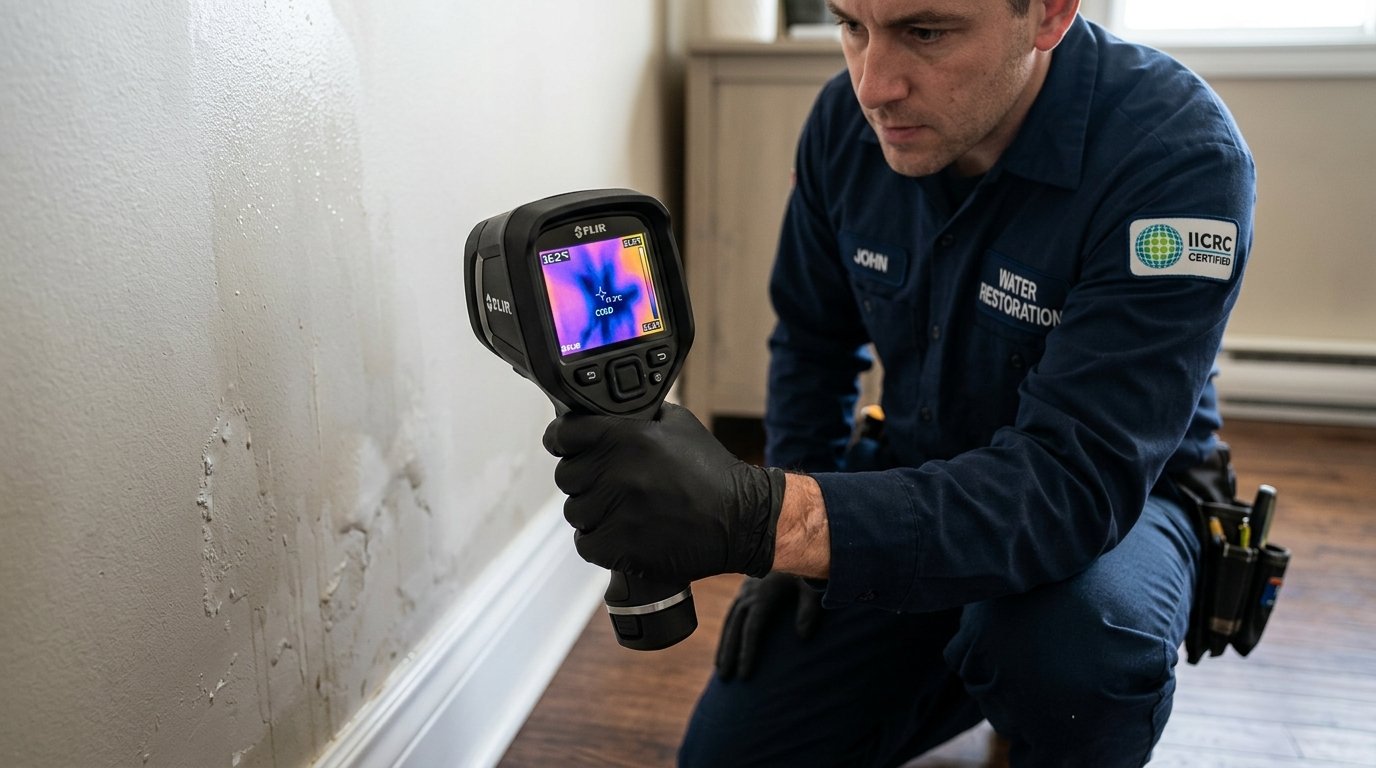
Technicians utilize FLIR Thermal Infrared Cameras operating in the long-wave infrared spectrum (7.5 to 14 μm) based on the thermodynamic principle of evaporative cooling:
As water evaporates from porous building materials, it consumes latent heat of vaporization (approximately 970 BTU per pound of water evaporated), lowering the surface temperature of the wet drywall by 2°F to 8°F compared to surrounding dry materials. Thermal cameras detect emissivity variations down to 0.03°C, displaying hidden moisture perimeters, saturated insulation, and slab leak paths as distinct cold blue and purple thermal maps in real time.
4. Pinless vs. Pin-Type Moisture Meters: Calibration Standards
After thermal anomalies are mapped, technicians calibrate precision electronic moisture meters:
| Diagnostic Tool | Operating Principle | Penetration Depth | Field Application |
|---|---|---|---|
| Pinless Dielectric Meter (Protimeter MMS3) | High-frequency radio wave impedance measurement. | Up to 0.75" depth. | Rapid non-destructive mapping of ceramic tile, hardwood flooring, and painted drywall without surface damage. |
| Pin-Type Resistance Meter (Delmhorst BD-2100) | Direct electrical conductivity between two insulated electrode probes. | Up to 2" structural depth. | Measuring exact percentage of Moisture Content (% MC) inside bottom wood sill plates, studs, and subfloors. |

5. Acoustic Frequency Ground Microphones for Slab Leaks
When pressurized plumbing lines rupture 4 to 8 inches beneath solid concrete foundation slabs, technicians deploy electronic acoustic listening sensors. These devices utilize piezoelectric ground microphones that amplify the high-frequency vibrations (400 Hz to 2,500 Hz) generated by pressurized water spraying against concrete aggregate. By adjusting electronic band-pass filters, technicians isolate the leak sound and pinpoint the fracture location to within 2 inches.
6. Borescope Video Inspection and Tracer Gas Methods
When visual confirmation inside wall chases is required without tearing down drywall, a 1080p fiber-optic articulating borescope is inserted through a tiny 1/4-inch hole behind a removable baseboard. For ultra-small hairline leaks, non-toxic forming gas (5% hydrogen, 95% nitrogen) is injected into the plumbing line, and highly sensitive electronic sniffing probes detect gas escaping through micro-fissures in flooring.
7. Step-by-Step Homeowner Protocol When a Leak is Confirmed
- Isolate the Main Water Valve: Turn the main ball valve clockwise 90 degrees to immediately stop pressurized water loss.
- Turn Off Water Heater Power / Gas: Prevent dry-fire damage to heating elements if the water supply is drained.
- Call Certified Leak Detection Dispatch: Contact our 24/7 Sanford Emergency Team.
- Preserve Wall Integrity: Avoid destructive exploratory wall smashing before acoustic mapping is complete.
Frequently Asked Questions (Field Insights)
Thermal cameras detect the surface temperature variations caused by hot water slab leaks or the evaporative cooling of cold water pooling beneath flooring, creating a distinct thermal heat map of the moisture perimeter.
Normal dry drywall in Florida measures between 5% and 12% moisture content. Any reading exceeding 16% to 18% is considered elevated and susceptible to active microbial mold colonization within 24 to 48 hours.
Acoustic leak detectors utilize precision ground microphones and electronic noise filters to amplify the sound of pressurized water escaping a pipe fracture under solid tile and concrete slabs, pinpointing the exact spot.
Yes. Most Florida HO-3 policies cover the "tear out and access" costs required to locate and repair hidden plumbing leaks that cause sudden water damage, along with full structural drying and restoration.

Dealing with Water Damage in Sanford Right Now?
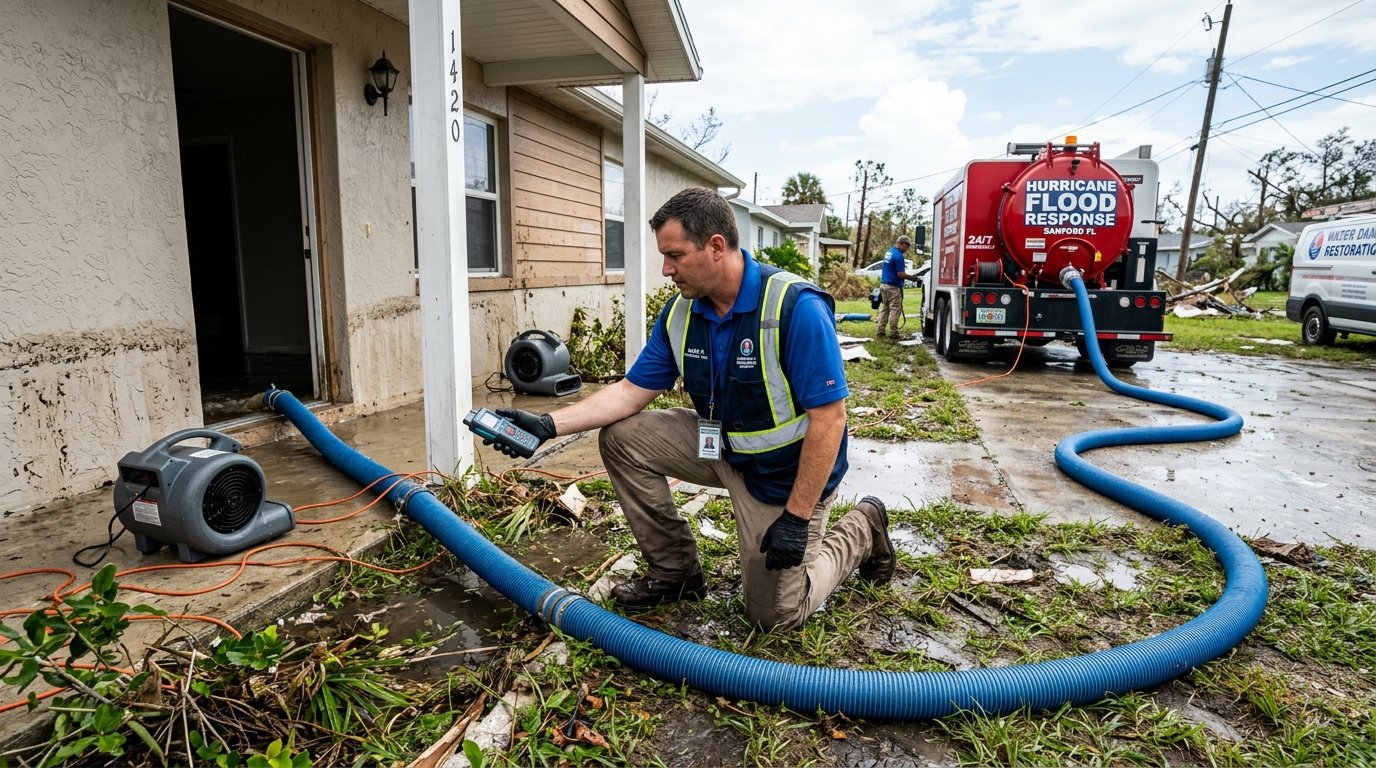
Don't wait for moisture to turn into structural mold. Our certified response team arrives on-site in 30 minutes across Seminole County with truck-mounted extractors, thermal cameras, and industrial drying equipment.
Call 24/7 Emergency Dispatch: (407) 871-3490